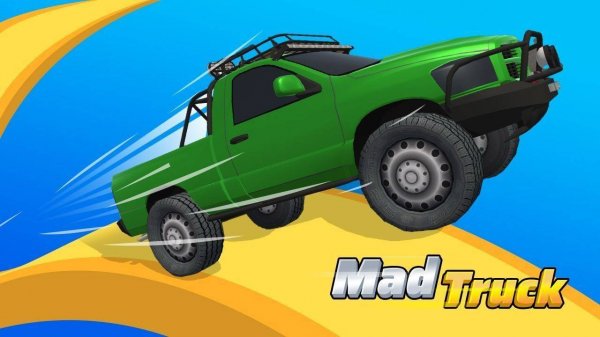
Heavy Cargo Route Master Arcade stands out for its commitment to physics-based driving. The truck feels heavy and responsive, making every turn and incline a test of control. The two camera angles force players to think differently about each obstacle, which adds welcome variety. Course design steadily introduces new challenges without becoming frustrating. The star rating system provides clear goals for improvement. This is a solid choice for anyone who enjoys driving games that reward patience and skill over reckless speed.
Each route in Heavy Cargo Route Master Arcade presents a distinct set of challenges. Players encounter steep inclines, narrow bridges, and platforms that shift under the truck's weight. The terrain varies from smooth roads to uneven dirt paths, requiring constant adjustments to speed and steering angle. Some sections demand a slow, deliberate approach to avoid tipping, while others allow for brief bursts of acceleration. The layout of each course encourages players to study the path ahead and plan their movements accordingly.
The truck responds to every input with realistic weight and momentum. Accelerating too quickly on a slope can cause the rear wheels to lose traction, while braking abruptly may shift the load forward and upset the balance. Steering inputs must be smooth, especially on curved sections or when crossing narrow platforms. The physics engine simulates the truck's center of mass, making it essential to anticipate how the vehicle will react on different surfaces. Mastering these dynamics is the key to consistent performance.
Two distinct camera angles change how players approach each course. One view places the truck in profile, emphasizing lateral balance as the vehicle moves across side-facing platforms. The other offers a standard behind-the-vehicle perspective, which is better suited for navigating ramps and obstacles head-on. Each mode tests different aspects of control and spatial awareness. Switching between these perspectives keeps the gameplay varied and requires players to adapt their technique.
Courses are arranged in a sequence that gradually increases in complexity. Early levels introduce basic obstacles, while later stages combine multiple challenges in a single run. A star rating system rewards players who complete each course within a target time. Achieving a perfect score requires both speed and stability, encouraging repeated attempts to refine routes and improve timing. This structure provides a clear sense of advancement without relying on random elements.
The controls are designed to be intuitive, with on-screen buttons and tilt-based steering options. New players can pick up the basics quickly, but the physics-based mechanics offer enough depth to keep experienced drivers engaged. The game does not penalize experimentation, allowing players to learn through trial and error. This balance between simplicity and complexity makes the experience suitable for a wide audience, from casual players to those seeking a more demanding driving challenge.








Comments
0 comments