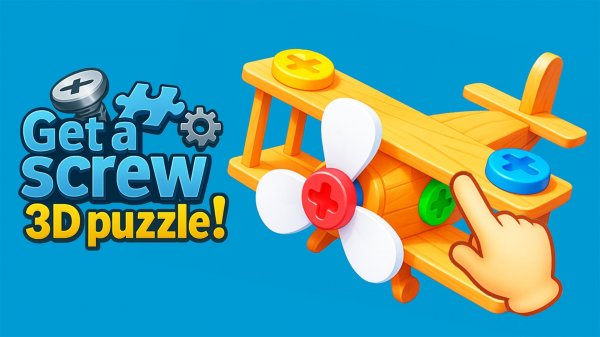
Spatial Logic: 3D Mechanical Puzzles offers a refreshing take on the puzzle genre by focusing on mechanical assembly rather than abstract shapes. The 3D environment is used effectively, requiring you to think about depth and perspective. The puzzles start simple but quickly become satisfyingly complex, demanding careful planning. The clean visual style and responsive controls make for a smooth experience. It is an excellent choice for anyone who enjoys logic-based challenges and wants to exercise their spatial reasoning skills.
At its heart, this is a puzzle game where you manipulate three-dimensional objects to complete mechanical assemblies. You are presented with a collection of parts, including screws, bolts, and shaped components, that must be joined together in a specific order. The challenge lies in understanding how each piece fits within the larger structure. You can rotate the entire object to view it from any angle, zoom in for a closer look at connection points, and interact with individual parts to attach or detach them. Success requires careful planning and a methodical approach, as the wrong sequence can block progress.
The puzzles are structured to gradually increase in complexity. Early levels introduce basic connections and simple shapes, allowing you to learn the controls and fundamental logic. As you advance, the mechanisms become more intricate, featuring multiple layers and interdependent parts. Some puzzles require you to disassemble a structure before rebuilding it, adding a layer of strategic thinking. The 3D environment is essential here, as depth and perspective play a key role in identifying which parts are accessible and how they interlock. This design encourages you to think in three dimensions, a skill that is both engaging and mentally rewarding.
The game provides clear visual cues to guide your actions. When you select a screw or a part, it highlights to indicate it can be moved. Successful connections are accompanied by a satisfying click and a visual confirmation that the piece is securely in place. This feedback loop is important for maintaining flow and reducing frustration. The 3D models are rendered with enough detail to distinguish different part types, but the style remains clean and uncluttered, keeping the focus on the puzzle itself. The interface is minimal, with only essential controls visible, which helps you stay immersed in the task.
The game offers a growing collection of levels, each with a unique mechanical challenge. As you complete puzzles, you unlock new ones, providing a clear sense of progression. There is no time pressure, allowing you to work at your own pace. This makes it suitable for both quick play sessions and longer, more focused problem-solving. For those who enjoy mastering their skills, the game may include optional challenges or efficiency metrics, such as tracking the number of moves or the time taken to complete a puzzle. This adds a layer of replayability for players who want to improve their performance.









Comments
0 comments