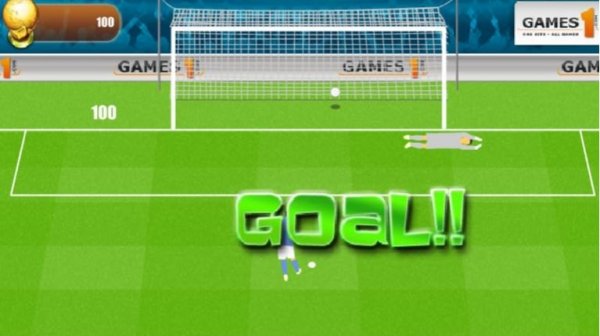
Goal Line Standoff strips away everything except the core drama of a penalty kick. The three-meter aiming system feels intuitive yet requires genuine skill to master, and the goalkeeper mechanic adds a satisfying layer of anticipation. Matches are short enough to fit into a coffee break but tense enough to keep you coming back. The tournament bracket gives a sense of progression without overcomplicating the experience. It is a well-executed, family-friendly sports game that respects your time.
Each contest gives you five chances to convert from the spot and five opportunities to prevent the opponent from scoring. The team that finishes with more goals wins. This format creates a compact, high-stakes environment where every kick matters. There are no lengthy halves or complex rules—just the pure drama of a shootout.
When it's your turn to shoot, a moving indicator appears at the bottom of the screen. Your first click determines the ball's horizontal direction. A second meter then appears to set the height of the shot, and a third controls the power. Success depends on your ability to read these indicators and click at the right moment. Rushing often leads to weak or poorly placed shots.
Defending requires a different kind of focus. A brief visual cue appears in the net, hinting at where the opponent intends to place the ball. You then click anywhere in the goal area to make your keeper dive. Timing is critical—dive too early or too late, and the ball slips past. Staying calm and watching the cue closely gives you the best chance to make a save.
The game organizes matches into a tournament bracket. You face a series of national teams, each with its own style. Progressing through the bracket requires consistent performance across multiple shootouts. This structure adds a layer of long-term challenge beyond a single match, encouraging you to refine your technique as you advance.
Goal Line Standoff runs directly in web browsers on both desktop computers and mobile devices. There is no need to download or install anything. The simple control scheme translates well to touch screens, making it easy to play on a phone or tablet during a commute. The interface is clean and uncluttered, keeping the focus on the action.
Improvement comes from repetition and observation. Learning to anticipate the opponent's shot patterns, controlling your own nerves during the final kick, and developing a consistent timing for both shooting and saving are the main paths to mastery. The game rewards patience and practice rather than complex button combinations, making it accessible to newcomers while still offering depth for those who want to perfect their technique.



Comments
0 comments