This counting activity stands out for its patient, encouraging approach. By removing time limits and penalties, it lets children focus on understanding the relationship between digits and quantities. The variety of fruits and vegetables adds visual interest while subtly promoting healthy eating awareness. The simple touch interface works well on tablets and phones, making it a practical tool for parents and teachers. It is a solid choice for early math practice that respects a child’s natural learning pace.
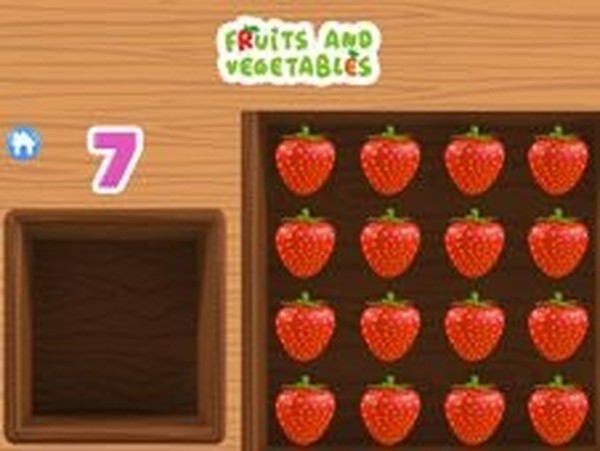
At the start of each round, a single digit appears on the left side of the screen. On the right, a collection of garden foods such as tomatoes, oranges, bananas, peas, strawberries, and radishes is displayed. The child’s task is to select the correct number of items from the pile and place them into a box. Each selection is counted aloud or visually tracked, helping children connect the abstract digit with a concrete quantity. This one-to-one matching process is a foundational skill in early math education.
The game uses bright, friendly graphics to present each food item clearly. Different rounds feature different combinations of fruits and vegetables, which keeps the activity fresh. By working with familiar foods, children naturally learn to recognize and name healthy produce. The visual variety also helps maintain attention during repeated play sessions.
There are no timers or penalties for wrong answers. Children can take as long as they need to count and select items. This low-pressure environment allows kids to focus on accuracy rather than speed. Immediate feedback after each selection shows whether the count is correct, which reinforces learning without causing frustration. The game can be played multiple times to build confidence.
The interface relies entirely on visual cues and simple touch interactions. No reading ability is required, making the game usable by children who have not yet learned letters. Large buttons and clear icons ensure that even very young players can navigate independently after a brief demonstration. This design makes the activity suitable for a wide range of early learners.
Available on mobile phones and tablets, the game can be used anywhere—during travel, at home, or in a classroom. The touch-based controls are intuitive for small hands. Parents or teachers can sit alongside the child to offer guidance during the first few rounds, then let the child practice alone. The compact format allows for short, focused learning sessions that fit into daily routines.








Comments
0 comments